
Where breathing,
feeding, and growth align.
Airway-focued care for infants and growing children.
Not rushed. Not routine. Truly personalized.

WELCOME
Welcome to Honeybee
Pediatric Airway & Tongue-Tie

At Honeybee, we look beyond teeth.
We evaluate how your child breathes, feeds, and grows, because they’re all connected.
Every child is seen through a functional, collaborative, and airway-centered lens.


It truly takes a hive to help a child thrive.
And we're honored to be part of your child's journey.

MEET DR. NEZ MUKU
Hi, I'm Dr. Nez.
At Honeybee, our care is led by Dr. Nez Mutlu, Board-Certified Pediatric Dentist, who has focused her continuing education on pediatric tethered oral tissues (TOTs) and their relationship to oral function and development. This includes oral dysfunction related to feeding, swallowing, speech, and pediatric sleep-disordered breathing.
We believe the face, airway, teeth, posture, sleep, and overall health are deeply interconnected. That’s why our care goes beyond treating symptoms—we seek to understand the whole child. When indicated, we provide gentle, precise tongue-tie and lip-tie releases and work closely with a trusted network of lactation consultants, bodyworkers, therapists, internists, pediatricians, and medical providers.
-
Dr. Nez’s “why” began close to home. As a mother, she wanted to truly understand early oral development, airway health, and function for herself, so she could be certain she was doing the very best for her own children. That same commitment now guides how she cares for every child and family she serves. Her approach is thoughtful and individualized, focused not only on teeth, but on how a child breathes, feeds, sleeps, and functions as a whole.
Our Services

-
A gentle tongue-tie release can help babies nurse more comfortably, improving latch and easing feeding frustrations for both baby and parent. It can also support better weight gain, reduce gas or colic symptoms, and promote healthy oral development as your little one grows. We will do our best to schedule in 24-48 hours from contact.

-
For older kids, releasing a tongue-tie can gently improve speech clarity, make eating and swallowing more comfortable, support better movement, and even help with oral hygiene by allowing the tongue to move more freely. Here we guide patients through pre- and post-operative myofunctional exercises which are an essential part of our care protocol. Sutures and glue are placed for optimal healing and to stabilize the area, while the wound heals naturally by secondary intention.

-
Pediatric sleep-disordered breathing can range from snoring to obstructive sleep apnea (OSA) and is often related to a narrow upper jaw. Airway screening helps us evaluate how your child breathes and sleeps. When appropriate, maxillary expansion may be recommended to gently widen the upper jaw, support nasal breathing, create space for the tongue, and promote healthy airway and facial development.

-
As part of our whole-child approach, we offer photobiomodulation (PBM)—a gentle light therapy that helps support your child’s healing process. It is a calming, non-invasive treatment that helps reduce inflammation, support tissue healing, improve circulation, and enhance comfort and recovery.
Not sure where to start? Every journey begins with a comprehensive airway evaluation.
Lip & Tongue Tie Release
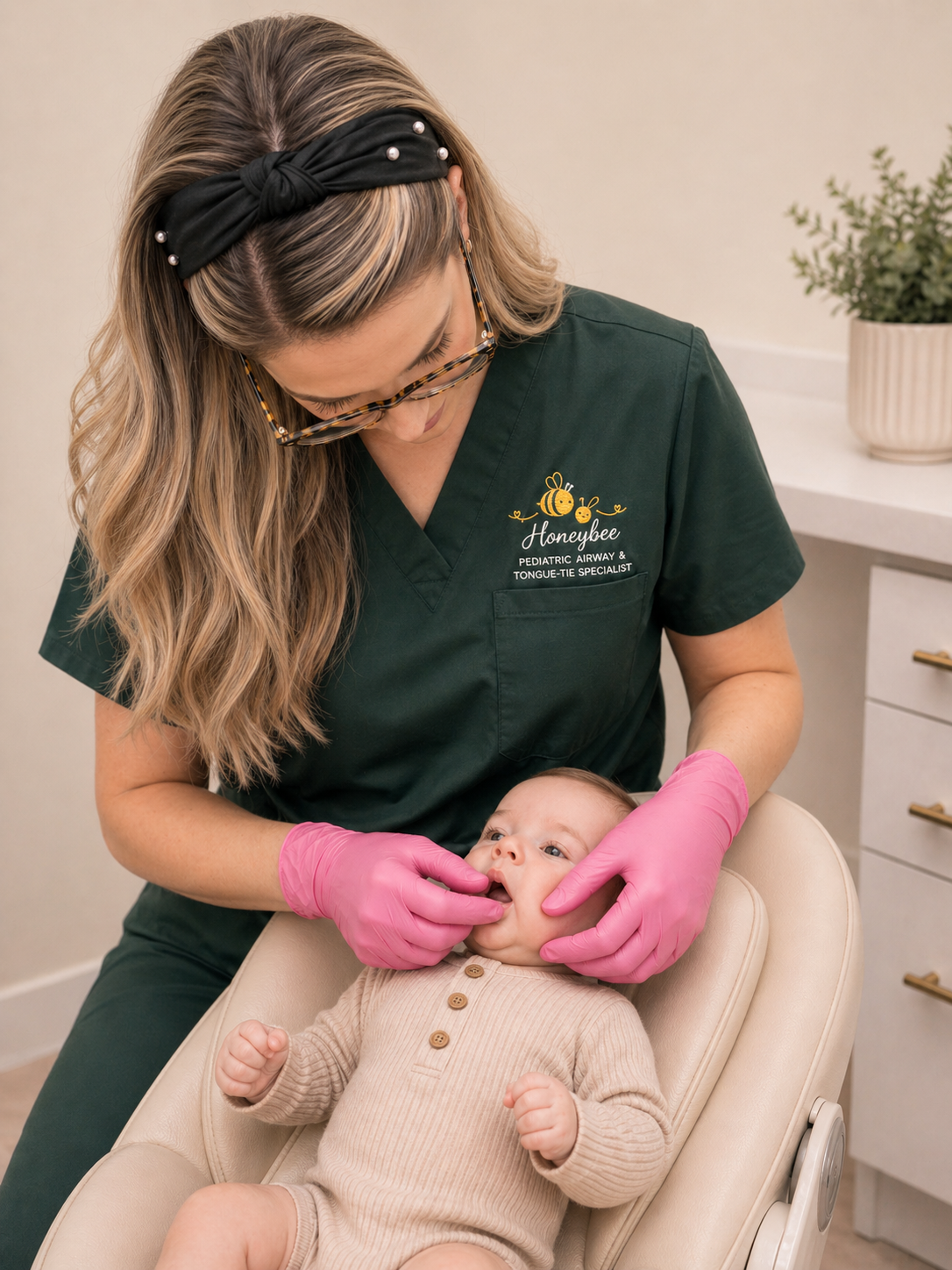
At Honeybee, we understand the first months of life are foundational. Tongue function, airway health, and feeding coordination shape how babies grow, sleep, and thrive.
Our consultations are thoughtful and unrushed, focusing on how your baby feeds, breathes, rests, and uses their mouth in real time. When care is recommended, it’s gentle and intentional—guided by function and anatomy, never urgency.
Dr. Nez brings over a decade of experience in laser-assisted soft-tissue procedures, using LightScapel CO₂ technology for precise releases, minimal thermal impact, and optimal healing—especially for infants and young children.


Pediatric Sleep
Pediatric sleep issues can range from mouth breathing, snoring, and restless sleep to obstructive sleep apnea (OSA), often caused by airway narrowing when throat muscles relax during sleep.
Because quality sleep is essential for growth, behavior, and overall health, Dr. Nez takes a collaborative, team-based approach to care.
Sleep concerns are complex and require thoughtful evaluation. Beyond symptoms, Dr. Nez focuses on identifying the root cause of airway obstruction and works closely with your child’s ENT and medical team when needed.
We collaborate with IbCLes, myotunctonal therapists, bodyworkers pediatricians, and other specialists to support your child, together.
Because your child deserves a team. ♡
FAQ’S
-
A tongue-tie (ankyloglossia) occurs when the thin band of tissue under the tongue (the lingual frenulum) is too tight, thick, short, or restrictive. This limits the tongue’s natural range of motion and can affect feeding, breathing, speech, oral development, and sleep. Regardless of the method of feeding (Breastfeeding or bottle feeding) the suck/swallow process is a full time job for a baby. A tight frenum can make that job difficult and tiring.
-
A lip-tie (labial) happens when the tissue connecting the upper lip to the gum is tight or restrictive. Can led to a shallow latch and upper lip dimple while feeding. If the baby is nursing well-enjoy your nursing relationship. In other words, if it’s not causing a problem, there is no need for a procedure at this time.
-
are tight bands of tissue (frenula) that connect the inside of the cheeks (buccal mucosa) to the upper or lower gums. When these bands are too short, thick, or restrictive, they can limit normal cheek movement and function—especially in babies and children.
-
Restricted tongue movement can impact how a baby latches, transfers milk, swallows, breathes, and develops oral strength.
Common symptoms include:• Painful breastfeeding (sore and flattened nipples after feeding)
• Poor latch or frequent slipping
• Clicking while nursing or bottle feeding
• Friction blisters or cobblestone appearance still present after the first month of birth
• Gassy, colicky behavior
•Torticolis
•Plagiocephaly
• Slow weight gain
• Frequent and Prolonged feeds
• Reflux-like symptoms
• Milk Tongue (baby can’t lift tongue high enough to rub against the palate)
• Decreased milk transfer
• Proper lip flange
• Plugged ducts/Mastitis
• Fatigue at the breast/Cluster feeding
• Invisible lower lip due to recessed chin
• Baby tongue doesn’t lift while crying
• Tongue cupping or heart-shaped tongue
• High palate
-
In toddlers and children, tongue-ties may contribute to:
• Mouth breathing
• Snoring or poor sleep
• Speech delays or articulation challenges
• Dental crowding and mandibular teeth pulled back
• Cavities
• Narrow palate
-
• Picky eating or hypersensitive gag reflex
• Behavioral or attention challenges
• Chronic congestion
• Body tension
• Headaches
-
No. Not every tongue-tie needs treatment. At Honeybee, we evaluate:
• Function (how the tongue actually moves and works)
• Symptoms (feeding, breathing, sleep, speech, growth)
• Compensation patterns
• Airway impact
• Whole-body connection
We only recommend release when it is functionally necessary and beneficial for your child’s health and development.
-
We perform a comprehensive functional assessment, which may include:
• Visual and hands-on oral exam
• Range-of-motion testing
• Feeding assessment
• Airway and sleep screening
• Growth and oral posture evaluation
Collaboration with lactation, feeding, or therapy providers when needed
-
We use a gentle CO₂ laser (LightScapel) for tongue-tie and lip-tie releases. This allows for:
• Precise tissue release
• Minimal bleeding
• Reduced swelling
• Faster healing
• Lower risk of re-attachment
• Improved comfort
The procedure is quick and typically takes only a few minutes.
-
Most babies tolerate the procedure very well. Healing in the mouth happens quickly and babies heal faster than adults. The CO₂ laser minimizes trauma, and we use comfort-focused techniques to keep your child calm and supported. Some mild fussiness or soreness for 24-48 hours is normal and temporary. We recommend skin-to-skin time, frozen breast milk, or over the counter pain meds and we have more natural alternative pharmaceuticals for discomfort as well.
-
Some families notice immediate improvement, while others see gradual progress over days to weeks as oral muscles learn to move properly. Healing, nervous system integration, and muscle coordination all play a role in timing.
-
Current literature and expert opinion recommend Stretches which help minimize the tissue from re-attaching during the healing phase. While they can feel intimidating, they are critical for long-term success and optimal outcomes.The stretches will keep the wound open and allow the fibers to grow with length, resulting in more elasticity post-release.We provide clear, gentle guidance and support throughout the entire process. Healing happens very quickly in infants- they are new and fresh with cells that proliferate at a great speed. Dr. Nez believes it is important to follow-up frequently.
-
The near-infrared laser light (wavelength of non-ionizing laser energy used is 1064nm) interacts with tissues at the cellular level and metabolic activity increases within the cell, improving the transport of nutrients across the cell membrane. This initiates the increased production of cellular energy (ATP) that leads to a cascade of beneficial effects, increasing cellular function and heath. It is gently applied to targeted areas of the head, neck, and oral tissues. This light is non-invasive and non-thermal, meaning it has a safer tissue interaction no thermal risk and does not damage tissue or DNA. Patients typically experience only a mild, soothing warmth.
At the cellular level, this light energy is absorbed by the mitochondria, helping to:
Increase cellular energy (ATP production)
Improve blood flow and oxygen delivery
Reduce inflammation
Support tissue repair and regeneration
As circulation improves and inflammation decreases, tissues become more relaxed and functional. This can help relieve tension within the fascial system and surrounding musculature, allowing for improved mobility and comfort.
PBM may also support the nervous system by:
Enhancing nerve signaling
Improving coordination between nerves and muscles
Promoting more balanced reflexes and functional movement patterns
The result is an environment where tissues are not only able to heal, but can return to a more optimal state of function. For best outcomes, PBM is often combined with supportive therapies such as myofunctional therapy, bodywork, or osteopathic care to reinforce healthy movement patterns and long-term stability.
-
Yes. We strongly believe in collaborative care and frequently work alongside:
• Lactation consultants
• Myofunctional therapists
• Bodyworkers (CST, PT, OT)
• Speech therapists
• Pediatricians and ENTs
Optimal outcomes happen when the whole system is supported.
-
Releases can be performed in:
• Newborns
• Infants
• Toddlers
• Children
• Adults
Each age has unique considerations, which we review carefully with your family.
-
Yes. The tongue plays a critical role in airway development, oral posture, swallowing, and breathing. Proper tongue posture supports an open airway. Restricted tongue mobility can contribute to:
• Mouth breathing
• Poor sleep quality
• Snoring
• Under-developed jaws
• Narrow arches
• Long-term airway challenges
Early intervention supports healthier airway growth.
-
If your child has challenges with:
• Feeding
• Breathing
• Sleep
• Speech
• Mouth breathing
• Snoring
• Reflux-like symptoms
• Poor latch
• Dental crowding
We use the Fairest-6 (Functional Airway Evaluation Screening tool) framework to asses the Red Flag Exam Findings for Pediatric Sleep-Disordered Breathing (SDB) for example mouth breathing, mentalis strain, tonsillar hypertrophy, and ankyloglossia. We focus on function, rest, posture, tone, and airway patterns.
-
Oral Motor Functional assessment (tongue range of motion, lingual palatal seal, maxillary intercaine distance, and facial structural changes). Pediatric Sleep Questionnaire, Imaging (cone beam computed tomography or CBCT), Orthodontic models and expansion. We look at breathing at rest, lip seal, suction, feeding efficiency (breast, bottle, cup), tongue elevation and lateralization, allergies, congestion, tongue-palate awareness, jaw stability, pacifier/thumb use, feeding portions, screen time/posture, palate shape, hypotonia vs. hypertonicity. Neuroplasticity is highest before the age of 4-we are shaping habits before skeletal compensation.
An evaluation may be helpful—if you’re unsure.
-
Honeybee Pediatric Airway & Tongue-Tie operates as an out-of-network specialty practice. This allows us to provide:
• Longer visits
• Individualized care
• Advanced technology
• Comprehensive evaluations
• True one-on-one attention
We can provide superbills for families who wish to seek insurance reimbursement.
You don’t have to navigate this alone.
Were here to help your child thrive.

Contact Us
For Appointments, Questions, Or Anything Else You Need—We’re Here
Phone: (480) 915-8510
Fax: (480) 439-1122
Full Life Medical
9475 East Ironwood Square Drive, Suite 102,
Scottsdale, AZ. 85258